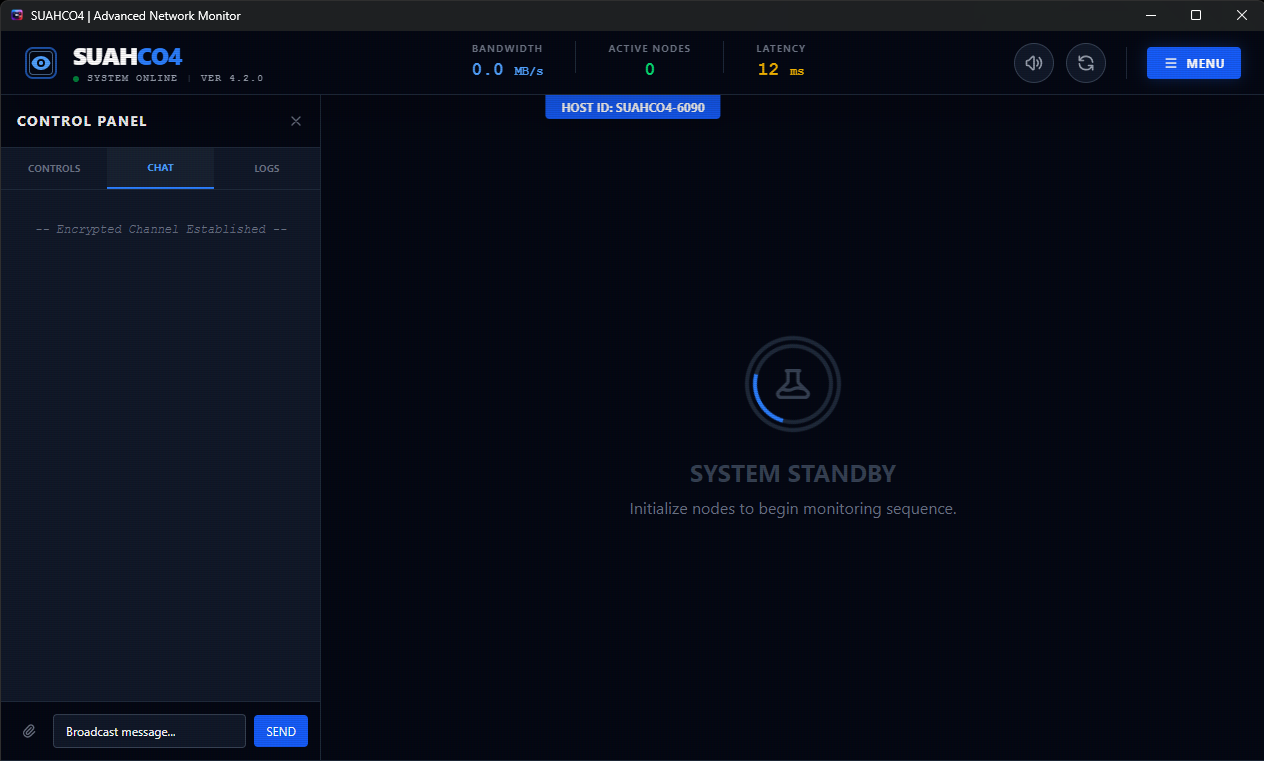
Advanced network monitoring and real-time screen casting powered by low-latency WebRTC and end-to-end encryption.
Proprietary WebRTC implementation ensures sub-50ms latency across global peer connections.
AES-256 end-to-end encryption for all data and video streams. Your network remains your business.
Monitor 1 to 100+ nodes simultaneously with dynamic grid layouts and automated health checks.
Watch the SUAHCO4 platform in action, demonstrating real-time monitoring and node management capabilities.
Select your platform to begin deployment.
The SUAHCO4 platform utilizes an advanced WebRTC implementation to facilitate high-performance, peer-to-peer data and video transmission. By establishing direct connections between nodes using STUN and TURN server infrastructure, we eliminate the need for centralized media servers, which significantly reduces latency and operational overhead.
The PeerJS protocol is leveraged for initial handshaking and peer discovery, ensuring that your network remains resilient even in complex NAT environments. This hybrid approach allows for seamless connectivity across diverse network topologies while maintaining the highest quality of service.
Security is the cornerstone of the SUAHCO4 architecture. Every stream and data packet is protected by industry-standard AES-256-GCM end-to-end encryption. Our zero-knowledge framework ensures that session keys are generated locally on your hardware and are never shared with our signaling servers.
Furthermore, the platform supports private network isolation, allowing users to operate entirely within local WiFi environments without external internet access. This "air-gap" compatibility makes SUAHCO4 ideal for sensitive industrial or secure research environments where data privacy is paramount.
Download the appropriate binary for your system. For Windows, execute the provided installer and follow the setup wizard. For Android, sideload the APK and grant the necessary camera and screen recording permissions when prompted by the OS to ensure full functionality.
The Windows client requires a 64-bit installation of Windows 10 or 11. The Android client requires an ARM64 device running Android 10 or higher. A stable network connection with at least 5Mbps upload for 1080p streaming is recommended for optimal performance.
Launch the application and select 'Create Control Room' to act as a host. Share the generated unique Host ID with remote agents. Agents can then enter your ID and select 'Connect' to initiate the encrypted handshake and begin the monitoring sequence.
Data Sovereignty Guaranteed
The SUAHCO4 privacy framework is engineered around the core principle of data sovereignty. We operate under a strict zero-knowledge architecture, meaning that the platform does not possess the technical capability to intercept, view, or store your transmitted data. All encryption keys are generated locally on your workstation and are never transmitted to our signaling servers, ensuring that your communication remains strictly between authorized nodes.
Unlike centralized monitoring solutions, SUAHCO4 does not perform metadata harvesting or behavioral tracking. Our signaling infrastructure is utilized solely for the initial ICE candidate exchange and peer discovery phase. Once a connection is established, the data flows exclusively through a direct peer-to-peer tunnel, effectively isolating your private network activity from third-party oversight or external collection protocols.
For organizations requiring automated workstation management, SUAHCO4 provides a comprehensive REST-based API and WebSocket hook system. The API allows developers to programmatically initialize control rooms, query the health status of active nodes, and trigger remote system protocols across the distributed network. This allows for seamless integration into existing IT service management (ITSM) dashboards and automated security orchestration layers.
Our developer toolkit includes a standardized JSON telemetry format for all system logs and performance metrics. By leveraging our WebSocket event listeners, your internal applications can react in real-time to connection handshakes, high-latency alerts, or security heartbeat failures, providing a highly extensible foundation for custom industrial or research-grade monitoring solutions.